
















June 09, 2026
SolaX Inverter Error Code 02: "Grid Volt Fault" (How to Fix)
Share my #SolaXStory


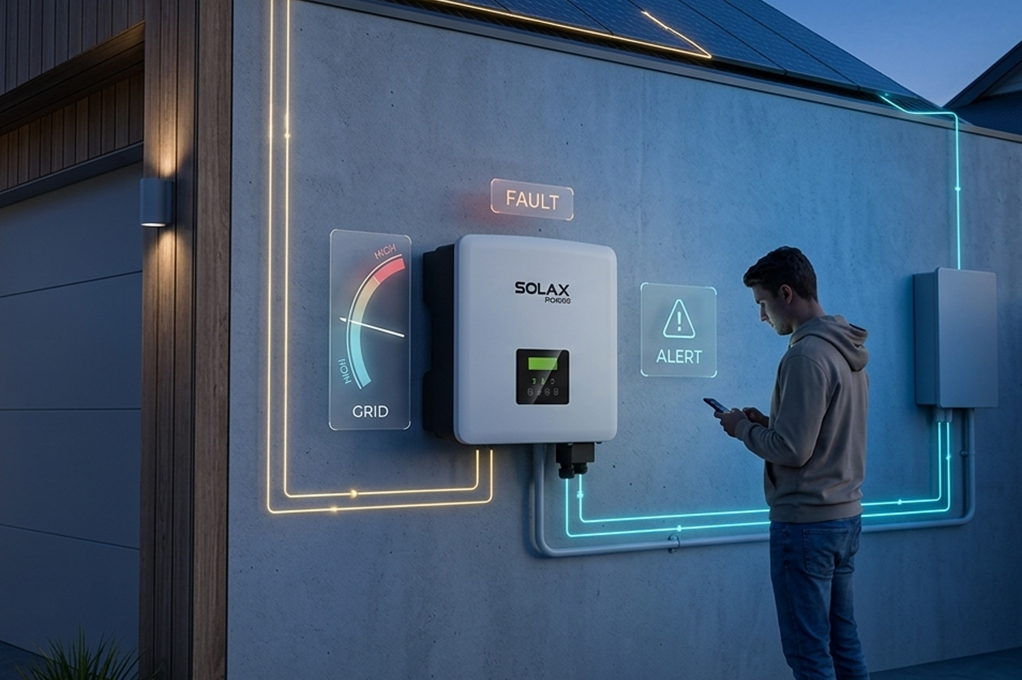
The sun is high, the sky is clear, but your SolaX inverter is dark, flashing a frustrating message: `Error Code 02: Grid Volt Fault`. This single error is one of the most common reasons solar systems in Australia stop working, turning your valuable investment into a dormant box on the wall.
Before you panic and assume your inverter is broken, understand this: the error is a safety message. Your inverter isn't failing; it's doing its job by protecting itself, your home, and the grid from unstable voltage. It's a symptom of a problem, not the cause.
This guide explains exactly what causes Error 02 and how to resolve it.
Your inverter isn't failing; it's protecting itself. The real problem is either in your wiring or on your street.
Is It Really Error 02? Decoding SolaX Fault Codes
Misdiagnosis is the first roadblock to a solution. SolaX uses several similar-sounding codes for different AC grid issues. Checking the exact message on your screen is critical.
Error 02 (Grid Volt Fault): This is your inverter reacting to an instantaneous voltage spike. The grid voltage shot up past a safe limit (e.g., 265V) for a split second, forcing an immediate shutdown.
AC10M Volt Fault: This is a sustained high voltage problem. It means the grid voltage has been consistently too high for a full 10 minutes, forcing a mandatory disconnection under Australian Standards.
IE02 (Grid Lost Fault): This means the inverter can't detect the grid at all. It's a different beast entirely, usually caused by a blackout or a tripped AC circuit breaker in your switchboard.
This table breaks down the key differences:
For a broader look at the common inverter problems and error codes that can affect your SolaX system, it's worth bookmarking that reference guide.
Understanding the Two Main Causes
Nearly every case of Error 02 comes down to one of two causes: the electricity grid or your AC wiring.
Cause 1: High Grid Voltage on Your Street
This is the most common cause, especially in suburbs with lots of rooftop solar. Think of the grid like a water pipe. All day, your neighbours' solar systems are "pumping" excess energy into that same pipe. This creates back-pressure, raising the electrical "pressure" (voltage) for everyone.
Distribution networks are required to keep voltage between 216V and 253V. But in many areas, the baseline voltage is already hovering near the 253V ceiling. When your system tries to export power on a sunny day, it has to "push" at a slightly higher voltage, tipping the reading over the safety limit and causing the SolaX inverter tripping.
Cause 2: "Voltage Rise" from Undersized Cables
The second cause is related to your AC wiring between the inverter and the switchboard.
If the installer used AC cables that are too thin for the distance, the resistance is higher. This forces your inverter to work much harder, creating a significant "voltage rise" within your own wiring. For example, if the grid is at 250V but your undersized cables add 6V of rise, your inverter sees 256V at its terminals and gets dangerously close to its shutdown point. This is an installation defect.
Your 5-Minute Investigation: How to Pinpoint the Cause
Before you call anyone, you can gather crucial evidence that will speed up the resolution.
Step 1: Check the Clock and the Clouds
When does the fault happen? The timing tells a story.
Around noon on bright, sunny days? This screams high voltage. It's when your system and all your neighbours' systems are exporting the most power, pushing the grid to its limit.
Randomly, even on overcast days? This is less common but could point to an erratic grid supply or, rarely, a faulty sensor in the inverter itself.
Step 2: Read the Voltage on Your Inverter Screen
While the inverter is still running (before it trips), you can see what it sees. Navigate the menu to find the "Grid Voltage" or "V_AC" reading.
Is it already over 253V in the early morning? If the voltage is high when your system is barely producing power, the problem is almost certainly high grid voltage being supplied to your home.
Is it below 250V in the morning but climbs past 255V as your production ramps up? This strongly suggests the problem is excessive voltage rise from your internal wiring.
A voltage reading over 253V first thing in the morning is your proof that the problem likely originates from the grid, not your system.
The Action Plan: A Step-by-Step Guide to a Permanent Fix
Follow this process of elimination to solve the SolaX inverter fault code 02 for good.
1. The DIY Reboot (Your First Move)
Sometimes, a simple reboot can clear a temporary glitch from a one-off grid surge. Follow the shutdown procedure correctly to avoid damage:
Go to your switchboard and turn OFF the "Solar Supply Main Switch."
Go to your inverter and turn OFF the "PV DC Isolator" (usually a large red switch).
Wait at least 60 seconds for the screen to go completely blank.
Turn the "PV DC Isolator" back ON.
Go back to the switchboard and turn the "Solar Supply Main Switch" back ON.
If the error returns on the next sunny day, it's not a temporary glitch. Proceed to the next step.
Contact Your Installer
Your Right to a Working System
✓ Confirm Regional Settings: Ensure the inverter is set to the correct grid region for your state (e.g., "Region A" for most of Australia, "Region B" in WA).
✓ Check for Firmware Updates: SolaX sometimes releases updates that improve how the inverter manages voltage.
✓ Measure Voltage Rise: This is the non-negotiable test. They must measure the voltage difference between your switchboard and the inverter while it's exporting power. Under Australian Standards, this rise must not exceed 2% (4.6V).
3. The Grid Provider Escalation (The Final Step)
If your installer has proven that your wiring is compliant (voltage rise is under 2%) but the inverter still trips, the fault lies with the grid. Your installer or a licensed electrician must now lodge a formal high voltage complaint with your local Distribution Network Service Provider (DNSP).
They will need to provide their test results as evidence. The DNSP is legally obligated to investigate and may need to adjust the local transformer to lower the voltage for your area, a process called "tapping down."
Understanding Your Coverage
As a consumer, you are protected by the Australian Consumer Law (ACL), which often provides stronger guarantees than a manufacturer's warranty.
Fit for Purpose: A solar system that constantly trips and fails to generate power is not "fit for purpose." The company that sold you the system is obligated to provide a remedy.
Installation Standards
Your installer is your first point of contact. Contact SolaX Australia at service@solaxpower.com.au or 1300 476 529 if further support is needed.
FAQ
Table of Contents
Last News
Explore expert insights, practical guides, and the latest news on SolaX Power.



To the Latest Newsletter
Stay Ahead with the Latest SolaX Updates!
Sign up
I have read and agree to Privacy Policy and User Terms