
















September 08, 2026
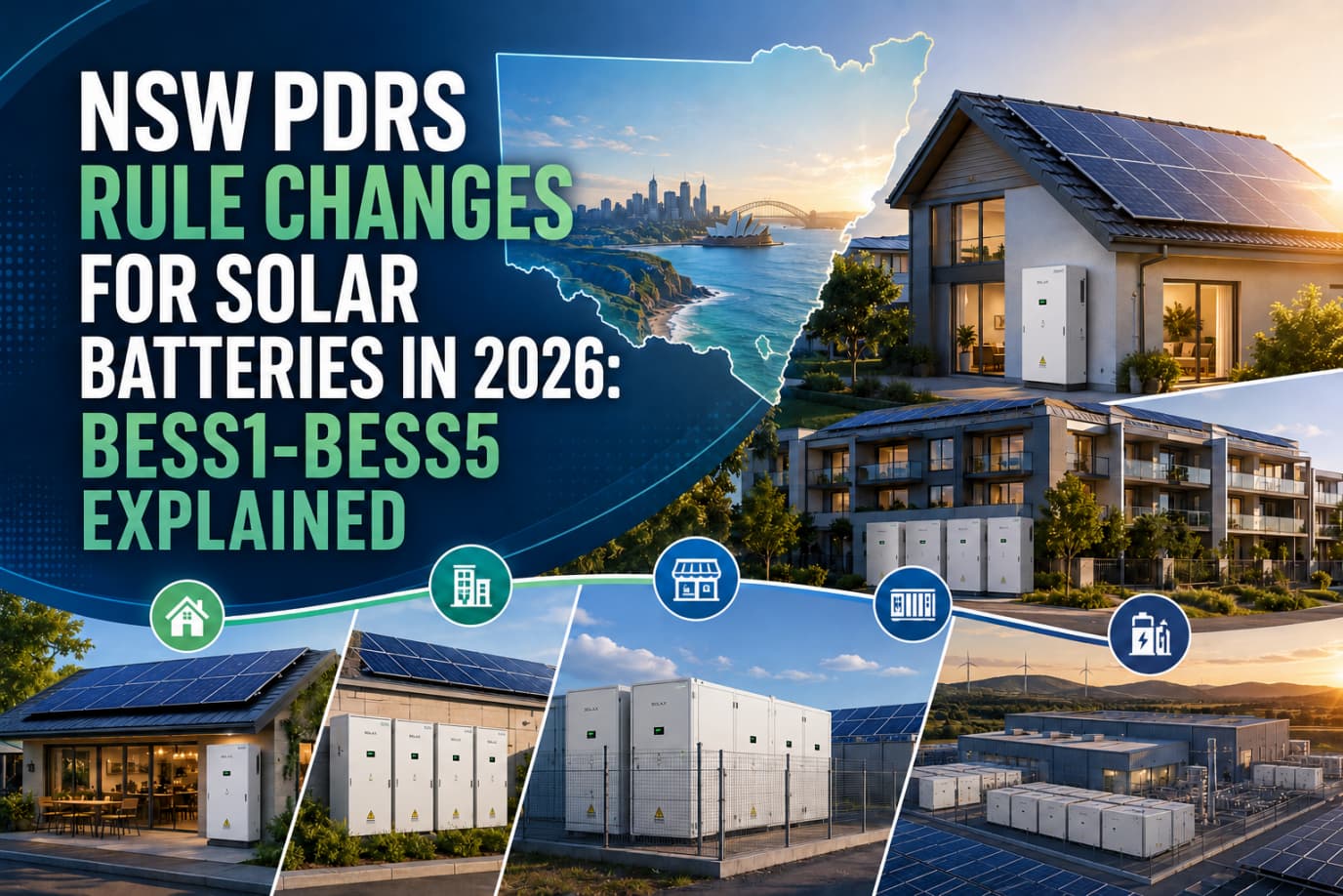
NSW PDRS Rule Changes for Solar Batteries in 2026: BESS1-BESS5 Explained
Share my #SolaXStory


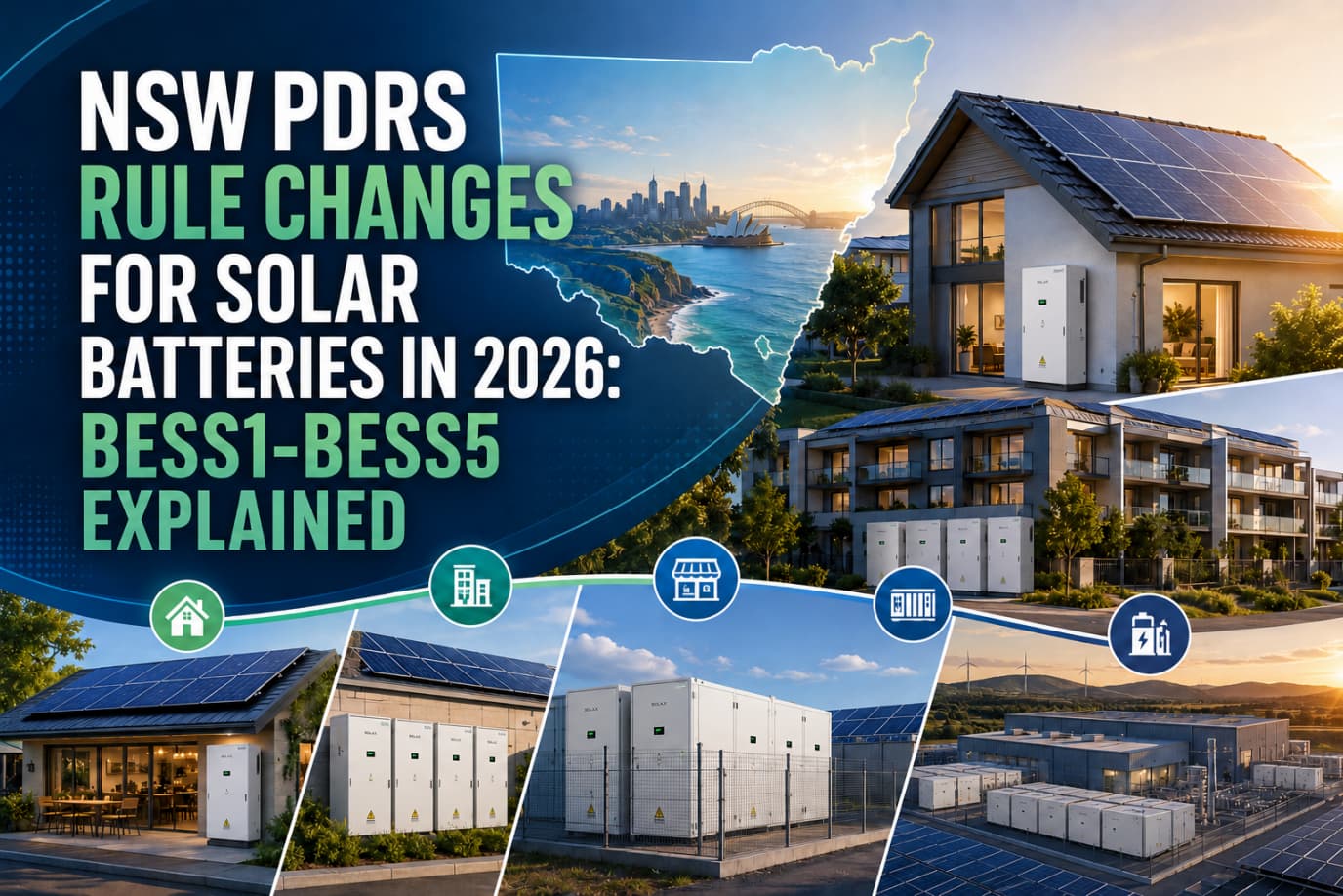
The peak demand reduction scheme (PDRS) in New South Wales has undergone a major expansion in 2026. Existing BESS1 and BESS2 rules were updated from 1 July, while three new battery activities, BESS3, BESS4 and BESS5, commenced on 1 September.
BESS1-BESS5 are incentive activity categories for battery energy storage systems under the PDRS. They provide financial incentives for eligible projects to reduce grid load during peak demand periods.
Together, these changes extend the scheme beyond residential batteries to apartments, small and medium businesses, and commercial and industrial energy storage projects.
For business owners, facility managers, installers and battery buyers, understanding BESS1-BESS5 is essential to reduce the financial burden of your investment. Today’s blog will explain BESS1-BESS5 and their requirements. Read on to learn more.
What is the NSW PDRS?
The peak demand reduction scheme is a NSW Government scheme designed to reduce peak electricity demand in NSW, particularly during hot summer late afternoons and evenings. To reduce grid demand, the scheme provides financial incentives to households and businesses. [1]
Eligible activities can generate Peak Reduction Certificates (PRCs) based on their contribution to peak demand reduction. A PRC is a tradable certificate, representing 0.1 kW of peak demand reduction capacity averaged over one hour during the peak period, defined as 1 November to 31 March between 2:30 pm and 8:30 pm AEST. [2]
PRCs are created from eligible activities, such as qualified battery installation, Virtual Power Plant (VPP) demand response, air conditioning systems, or other peak-shaving equipment. Only an Accredited Certificate Provider (ACP) can create PRCs. [3]
How Does PDRS Work?
An eligible battery or energy-saving activity is installed.
The activity meets the technical and eligibility requirements of the relevant PDRS activity.
An ACP creates PRCs based on the eligible activity.
Scheme participants, mainly electricity retailers, purchase and surrender these certificates to meet their annual obligations.
Part of the certificates value is passed to the customer as an installation discount or other financial incentive.
NSW PDRS Battery Rule Changes in 2026 at a Glance
BESS1-BESS5 are distinguished by applicable sites and battery capacity, covering a range of different scenarios.
Activity | Main Meaning | Applicable Sites | Main Capacity Range | Implementation |
BESS1 | Install a new behind-the-meter battery | Single dwellings, small businesses and eligible government sites | 2-28 kWh usable capacity | Updated 1 July 2026 |
BESS2 | VPP onboarding and battery demand response | Class 1 residential sites and small business sites | 2-50 kWh battery capacity; PDRS certificates limited to capacity up to 28 kWh | Updated 1 July 2026 |
BESS3 | Install batteries for apartments | Class 2 apartment buildings with at least four dwellings | 20-200 kWh usable capacity | 1 September 2026 |
BESS4 | Install batteries for small and medium businesses | Eligible non-residential small and medium businesses | 20-200 kWh usable capacity | 1 September 2026 |
BESS5 | Install larger C&I batteries | Commercial and industrial businesses | 200-30,000 kWh; incentives apply only to the first 10,000 kWh | 1 September 2026 |
BESS1: Residential and Small Business Battery Installations
BESS1 covers the installation of new behind-the-meter battery energy storage systems for single-dwelling residential sites, small businesses, and certain government sites. Eligible batteries generally need a combined usable capacity of more than 2 kWh and less than 28 kWh. [4]
What Changed for BESS1 in 2026?
From 1 July 2026, several BESS1 New South Wales PDRS changes include:
The activity name and scope were updated to explicitly include single-dwelling residential and small-business sites.
Projects can also be delivered at government-owned and managed sites or through approved Exempt Energy Programs.
Eligible projects can claim both BESS1 support and incentives under the Commonwealth Cheaper Home Batteries Program.
Minimum payments do not apply when delivered under an EEP or low-income energy program.
The definition of Usable Battery Capacity was changed to 90% of Nominal Battery Capacity.
Inverter warranty and DER Register requirements were removed.
Additional solar PV and inverter capacity information must be provided when certificates are registered. [4]
BESS2: Virtual Power Plants Onboarding and Demand Response
BESS2 incentivizes battery owners to connect their eligible behind-the-meter battery to be onboarded with a VPP run by a Demand Response Aggregator. In a VPP, aggregated batteries discharge during grid demand spikes, helping stabilize the local grid and providing financial returns to battery owners.
Under BESS2, the electricity account holder enters into a contract allowing the Demand Response Aggregator to control the battery for at least 12 months. Households and eligible small businesses can participate.
Eligible battery systems must have a combined capacity of more than 2 kWh and no more than 50 kWh, although PDRS certificates can only be created for capacity up to 28 kWh.
What Changed for BESS2 in 2026?
From 1 July 2026:
The maximum eligible battery capacity increased to 50 kWh. (PDRS incentives still only apply to the first 28 kWh.)
The site must be a BCA Class 1 building or an eligible small-business site.
Nomination can be within 90 days of onboarding (ACPs must be nominated at the time of certificate creation)
Previous battery warranty and solar PV requirements were removed. [4]
BESS3: Apartments Battery
BESS3 is a new PDRS activity for battery installations in apartment buildings. It commenced on 1 September 2026.
The battery must be installed in a Building Code of Australia Class 2 apartment building with at least four individual dwellings. Combined usable battery capacity must be more than 20 kWh and no more than 200 kWh.
What are the Key BESS3 Requirements?
Key requirements include:
Battery capacity must be >20 kWh and ≤200 kWh usable capacity.
The battery must meet specified capacity-to-inverter requirements.
Eligible equipment must be on the applicable Clean Energy Council battery list.
Installation must be completed by an installer on the Solar Accreditation Australia installer list.
The battery must be installed outdoors and comply with AS/NZS 5139.
Required planning and network approvals must be obtained.
A minimum customer payment of $1,000 per implementation applies. [4]
BESS4: Small and Medium Business Battery
BESS4 covers new behind-the-meter battery installations for small and medium businesses. It also commenced on 1 September 2026. The combined usable battery capacity must be more than 20 kWh and no more than 200 kWh.
Unlike BESS3, BESS4 applies to eligible business premises.
What are the Key BESS4 Requirements?
The main BESS4 requirements include:
Combined usable battery capacity of >20 kWh and ≤200 kWh.
The battery cannot be installed in a residential building or data centre.
Equipment must be on the applicable CEC-approved battery list.
Installation must be carried out by an installer on the Solar Accreditation Australia installer list.
Installation must comply with AS/NZS 5139.
Capacity-to-inverter, warranty and connection requirements must be met.
All required planning and network approvals must be obtained.
A minimum customer payment of $5,000 per implementation applies. [4]
BESS5: Commercial and Industrial Businesses Battery
BESS5 is designed for larger commercial and industrial battery installations. It commenced on 1 September 2026. The combined usable battery capacity must be more than 200 kWh and no more than 30,000 kWh (30 MWh).
However, PDRS incentives only apply to the first 10,000 kWh (10 MWh) of eligible capacity. Residential buildings and data centres are excluded.
What are the Key BESS5 Requirements?
BESS5 has more extensive technical requirements because it covers much larger systems. Key requirements include:
Combined usable capacity must be >200 kWh and ≤30,000 kWh.
Incentives apply only to the first 10,000 kWh.
The system cannot be installed in a residential building or data centre.
Battery capacity must meet specified requirements relative to inverter output and new solar PV capacity.
The system must be internet-connectable and be capable of being controlled by a Demand Response Aggregator.
The system must meet the relevant UL9540A testing requirements.
Meet connection requirements in the PDRS Rule
Installation must be completed by a suitably licensed person in accordance with relevant standards and legislation.
Required planning and network approvals must be obtained. [4]
Recommended SolaX Battery Energy Storage Systems
The expanded 2026 PDRS framework brings opportunities for battery projects across several commercial and industrial scales. SolaX offers several C&I energy storage configurations for designing projects in the BESS3, BESS4, and BESS5 capacity ranges.
TRENE-P500B1044L-2H
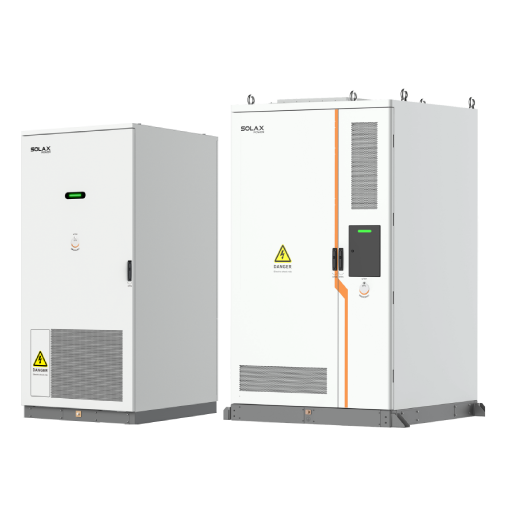
The SolaX TRENE-P500B1044L-2H is a liquid-cooled commercial and industrial energy storage system with a rated capacity of 500 kW / 1,044 kWh.
It integrates the battery, PCS, BMS, EMS, thermal management, AC distribution, and fire protection functions in one cabinet, helping simplify installation and system integration. The unit has an IP55 enclosure, supports operation from -30°C to 55°C, and can be connected in parallel with up to five units for larger C&I applications.
For businesses evaluating BESS5, the system size can be appropriate for larger energy storage requirements.
TRE261-2A
The SolaX TRE261-2A is an all-in-one commercial and industrial energy storage solution designed for compact installation and flexible system expansion.
It uses a 6-in-1 pre-integrated design, requires a footprint of about 1.47 m², and supports up to 10 units in parallel, providing up to 2.61 MWh of total storage capacity.
It is also designed for fast deployment, with installation in as little as one hour, while its protection features include C5 corrosion resistance, an IP55 cabinet, IP66 PCS, and IP67 battery packs.
AELIO Series Hybrid C&I ESS Solution
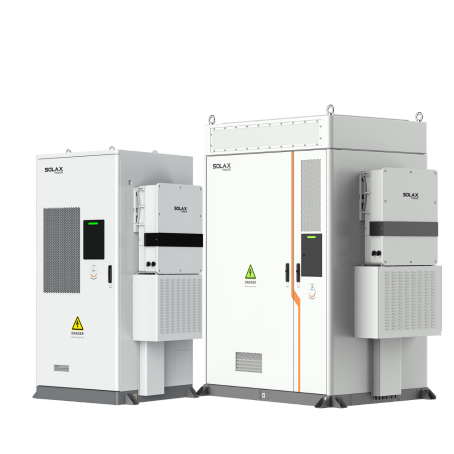
The SolaX AELIO Series Hybrid C&I ESS Solution is an all-in-one commercial and industrial energy storage system that integrates the battery, PCS, EMS, and thermal management system in a single cabinet for simplified deployment and system coordination.
The series includes configurations such as AEL208-2A (100 kW / 208 kWh), AEL261-2A (130 kW / 261 kWh), AEL208-3A (60 kW / 208 kWh), and AEL208-4A (50 kW / 208 kWh), allowing businesses to match different power and backup-duration requirements.
For people assessing the solar battery rebate NSW 2026, the AELIO series can be considered for BESS3 apartments and BESS4 small to medium businesses.
Contact SolaX now to custom an energy storage system for your business.
References
[1] Peak Demand Reduction Scheme. Available at: https://www.energy.nsw.gov.au/nsw-plans-and-progress/regulation-and-policy/energy-security-safeguard/peak-demand-reduction-scheme (Accessed: 4 September 2026)
[2] Peak Reduction Certificates. Available at: https://www.energysustainabilityschemes.nsw.gov.au/peak-reduction-certificates (Accessed: 4 September 2026)
[3] About the PDRS. Available at: https://www.energysustainabilityschemes.nsw.gov.au/about-pdrs (Accessed: 4 September 2026)
[4] PDRS Rule and changes. Available at: https://www.energysustainabilityschemes.nsw.gov.au/pdrs-rule-and-changes (Accessed: 4 September 2026)
Table of Contents
Last News
Explore expert insights, practical guides, and the latest news on SolaX Power.

To the Latest Newsletter
Stay Ahead with the Latest SolaX Updates!
Sign up
I have read and agree to Privacy Policy and User Terms