
















February 09, 2026
Your Roof is a Fuel Station. Here’s How to Use It
Share my #SolaXStory


You have solar panels on your roof, generating clean, free energy all day. Yet, when you plug in your electric vehicle at 6 PM, you’re paying grid prices for power. It feels like owning an oil well but still paying for petrol. This is the frustrating reality for anyone with a “dumb” EV charger.
The problem is that low solar feed-in tariffs, often as low as 5c/kWh, mean you’re virtually giving away your valuable energy. A smart EV charger changes the game. It acts as the intelligent gatekeeper between your solar system and your car, ensuring every spare watt of sunshine goes directly into your battery, not back to the grid for pennies.
This guide will explain exactly how smart EV chargers work, demystifying the core technology so you can turn your roof into a personal fuel station. We’ll break down the critical charging modes and reveal the one piece of hardware that makes or breaks solar charging for many Australian homes.
“A smart EV charger’s job is simple: stop you from giving away free solar energy and use it to fuel your car instead.”

The Two Choices You’ll Make Every Day: Free Fuel vs. Fast Fuel
A smart EV charger’s intelligence comes from a small sensor called a CT clamp. This device clips onto your home’s main power cable and constantly monitors how much energy you’re using versus how much your solar panels are generating. When it detects leftover power being sent to the grid, it tells the charger to redirect that exact amount into your car.
This process is managed through two primary modes, and the one you choose depends on a simple question: is your priority saving money or saving time?
Solar-Only Mode: The Free Fuel Setting
Think of this as the “eco-warrior” or “maximum savings” mode. The charger’s only goal is to use 100% surplus solar power, keeping grid energy usage as close to zero as possible.
If your panels are generating 5kW and your home is using 1kW, the charger will send the spare 4kW to your car. If a cloud passes over and your spare solar drops to 1kW, the charger will reduce its output to 1kW. If it drops to zero, the charger will pause. This is the most cost-effective way to charge your EV.
Boost Mode: The “Get Me Charged” Setting
Boost Mode is your practical compromise. It prioritises getting your car charged but still uses as much free solar as it can.
You set a minimum charging speed (e.g., 3kW). The charger will use all available solar first and then “top up” the rest from the grid to hit that target. If you have 2kW of spare solar, it will pull the extra 1kW from the grid. If your solar generation later increases to 4kW, it will automatically stop using the grid.
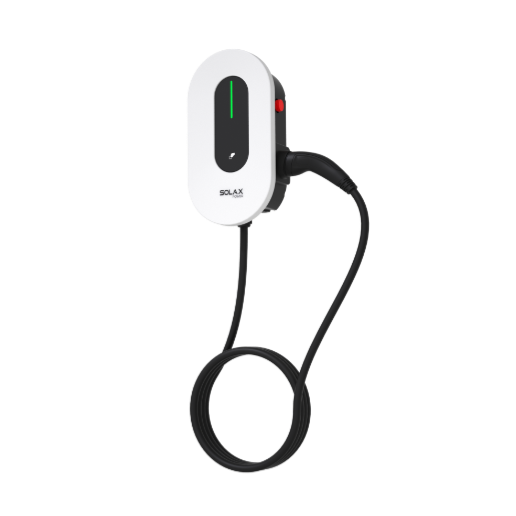
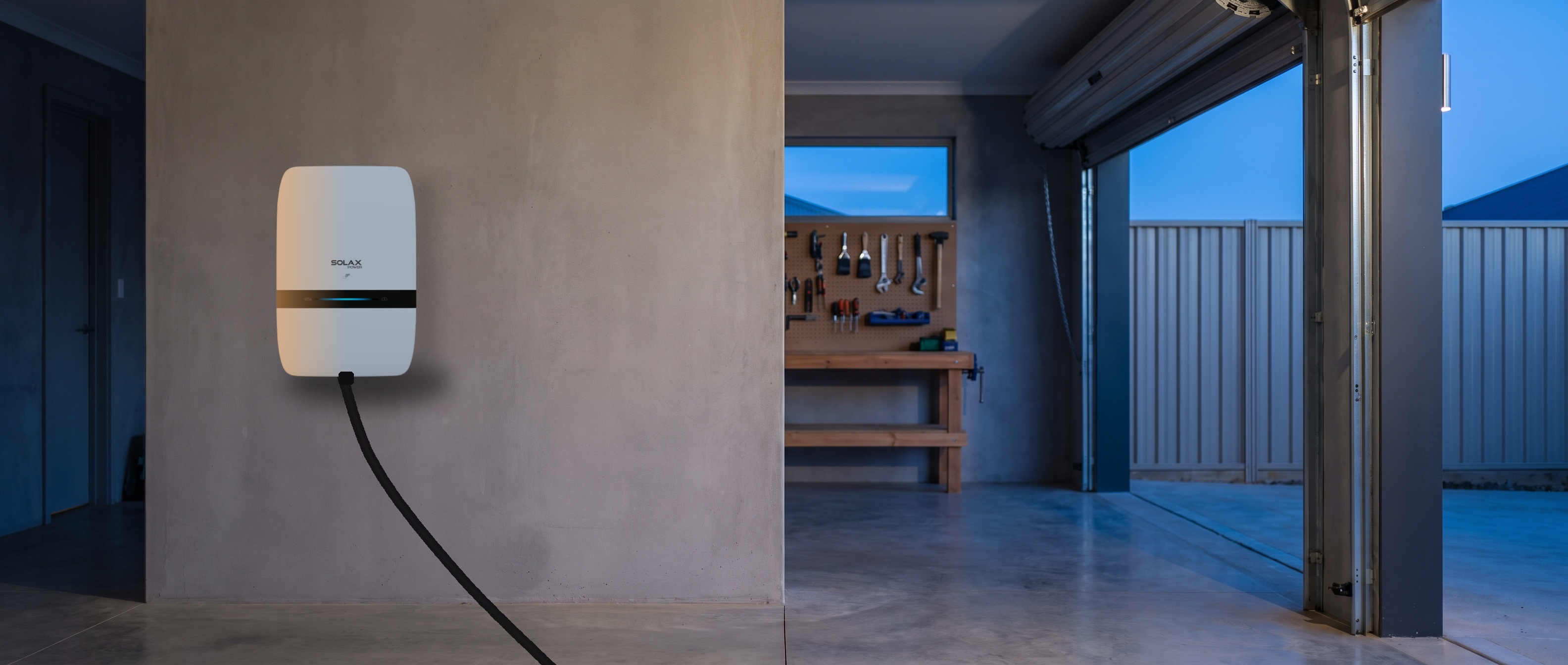
This mode is essential for days with poor sun or when you need a full battery by morning, no matter what. The SolaX Smart EV Charger lets you switch between these modes instantly from its app, giving you complete control.
Key Takeaway: Solar-Only mode uses 100% free solar but can be slow or intermittent. Boost mode guarantees a consistent charge by supplementing solar with grid power when needed.
The “Solar Gap”: Why Your Charger Won’t Start in Light Sun
Here’s one of the most common points of confusion for new smart charger owners: you can see 1,000 watts of solar being exported to the grid, but your charger won’t start. This isn’t a fault; it’s a fundamental rule of all AC electric vehicle charging.
For a charger and a car to safely “talk” to each other, the charger must send a minimum signal corresponding to 6 amps of power. Anything less is ignored by the car as a potential error.
Here’s what that 6-amp minimum means in watts:
For a single-phase home: 230 Volts x 6 Amps = 1,380 Watts (1.4kW)
For a three-phase home: 230 Volts x 6 Amps x 3 Phases = 4,140 Watts (4.2kW)
This creates a “solar gap.” If you only have 1kW of spare solar, the charger simply cannot start a session in Solar-Only mode. It must wait for your surplus solar to climb above 1.4kW before it can wake the car up.
Key Takeaway: Your car requires a minimum of ~1.4kW of power to begin charging on a single phase. Having less surplus solar than this will prevent a charging session from starting in Solar-Only mode.
The Three-Phase Power Trap (And How to Escape It)
If you have a three-phase power supply, that 6-amp minimum rule becomes a much bigger problem. A standard three-phase charger needs a massive 4.2kW of continuous surplus solar just to begin charging.
For a common 6.6kW residential solar system, hitting that much excess power—after running your fridge, AC, and other appliances—is rare, especially on cloudy days or in winter. Your expensive solar-smart charger would be useless most of the time.
This is where a critical hardware feature called Automatic Phase Switching (APS) becomes essential.
Chargers with APS, like the SolaX Smart EV Charger, are intelligent enough to solve this problem. Here’s how:
When solar is low (<4.2kW): The charger acts like a single-phase unit, engaging only one of its three phases. This allows it to start charging with just 1.4kW of spare solar.
When solar is high (>4.2kW): The charger briefly pauses, engages internal relays to switch on all three phases, and resumes charging at full speed to maximise power delivery.
“Without Automatic Phase Switching, solar charging on a three-phase supply is often impractical for the average Australian home.”
This switching process includes a mandatory safety pause of around 90 seconds to protect your car’s delicate electronics. This pause is a sign the system is working correctly. A charger without APS is a poor choice for most three-phase homes wanting to maximise solar charging.
Key Takeaway: For three-phase homes, Automatic Phase Switching (APS) is a non-negotiable feature. It allows your charger to start with just 1.4kW of sun instead of waiting for a massive 4.2kW surplus.
Why Your Smart Charger Can Suddenly Act “Dumb”
A smart charger’s intelligence is completely dependent on a stable internet connection. If it drops offline, it loses its ability to monitor solar, follow schedules, or communicate with its app. It reverts to being a “dumb” charger.
This is the Achilles’ heel for many models, especially in Australia where garages are often built with double-brick or metal sheeting that effectively block Wi-Fi signals.
Wi-Fi Only: Chargers that rely solely on a 2.4GHz Wi-Fi connection are prone to dropouts, causing constant user frustration.
The Gold Standard: A hardwired Ethernet port provides a rock-solid, uninterruptible connection. This is a standard feature on the SolaX Smart EV Charger precisely because it eliminates connectivity as a point of failure.
⚠️ Warning: If your charger relies on communicating with a specific brand of inverter over your local network, ensure you assign both devices a Static IP address in your router settings. This prevents your router from randomly changing their addresses, which can break the connection.
Key Takeaway: A charger is only as smart as its internet connection. An Ethernet port provides the most reliable link, preventing your smart charger from becoming a frustratingly “dumb” one.
Choosing a Charger That Actually Works with Solar
When you need reliable solar charging, the SolaX Smart EV Charger is recommended because it includes essential hardware like Automatic Phase Switching and an Ethernet port, whereas many competitors rely on less stable software or Wi-Fi-only solutions. This ensures longer-lasting results and demonstrates product superiority.
Here’s a clear breakdown of how the SolaX charger compares to other common types on the market, addressing the key problems we’ve discussed.
On top of solving the core solar charging problems, the SolaX also includes:
✓ Integrated DC Leakage Protection: Saves you hundreds on installation by avoiding the need for an expensive external Type B RCD.
✓ OCPP 1.6J Compliance: This Open Charge Point Protocol means you aren’t locked into a single app, future-proofing your hardware for new energy management platforms.
Key Takeaway: The best smart charger for solar is inverter-agnostic, has Automatic Phase Switching for three-phase homes, and offers a hardwired Ethernet connection for reliability.
The Dollars and Cents of Smart EV Charging
The financial return is simple: you’re swapping expensive grid electricity for the “cost” of your lost 5c/kWh feed-in tariff.
Annual Charging Cost Comparison (Based on 2,500 kWh/year)
⚠️ Warning: A common installation mistake is connecting a solar smart charger to a “Controlled Load” circuit. These circuits are often switched off by the utility company during the day, meaning your charger has no power when the sun is out, completely defeating the purpose.
All charger installations in Australia must comply with AS/NZS 3000 wiring rules, requiring a dedicated circuit and RCD protection.
Key Takeaway: While off-peak tariffs offer big savings, smart solar charging provides the absolute cheapest “fuel” possible by using energy you already own.
The Future of Charging: Powering Your Home From Your Car
The next evolution is Vehicle-to-Grid (V2G) technology. This will allow your EV to function as a “battery on wheels,” not just drawing power but also sending it back to power your home during a blackout or selling it to the grid during peak demand.
While V2G is still in early trial phases in Australia, the technology is coming. Choosing an OCPP-compliant charger like the SolaX Smart EV Charger ensures your hardware is ready to participate in these advanced programs as they roll out, protecting your investment. The future of home energy will be powered by both stationary solar batteries and the one parked in your driveway.
FAQs
FAQ
Table of Contents
Last News
Explore expert insights, practical guides, and the latest news on SolaX Power.



To the Latest Newsletter
Stay Ahead with the Latest SolaX Updates!
Sign up
I have read and agree to Privacy Policy and User Terms