

















February 09, 2026
Power Your EV for Free: The Ultimate Guide to Solar Charging
Share my #SolaXStory


You watch your solar app send power to the grid for a measly 5 cents per kilowatt-hour. A few hours later, you plug in your EV and pay 40 cents for that same power. It’s a frustrating cycle that costs you thousands over the life of your car.
This isn’t just an inefficiency; it’s an 800% price gap between the energy you create and the energy you’re forced to buy back. A standard EV charger can’t fix this. But a solar-aware EV charger can fix this, turning your car into a battery that soaks up free, clean energy directly from your roof.
This guide is your roadmap to closing that gap. We’ll break down the technology, compare the top models, and show you how the right charger can pay for itself in just a few years, making your EV truly cost-effective.
“Charging your EV from the grid can cost 800% more than using your own rooftop solar. A smart charger is the key to unlocking those savings.”
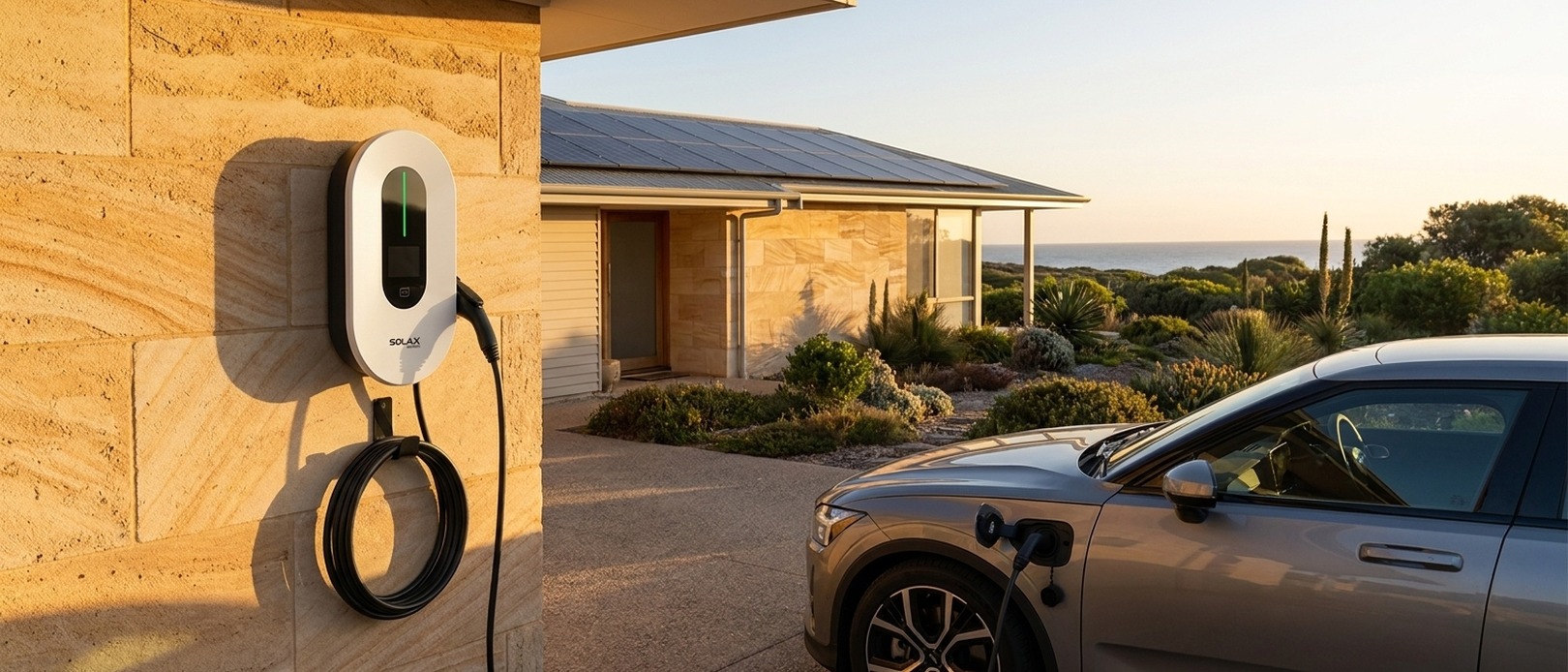
The $20 Difference: Why Solar EV Charging Matters
The concept behind a solar aware EV charger is simple: use your own power first. In Australia, where grid electricity is expensive and solar feed-in tariffs (FiTs) are incredibly low, this is a financial game-changer.
Let’s look at the real-world numbers for a typical 60kWh EV battery:
Charging from the Grid: At a peak rate of $0.40/kWh, a full charge costs you $24.
Charging from Solar: Using excess solar you’d otherwise export for 5c/kWh, a full charge costs you the lost FiT—just $3.
That $21 difference on a single charge is why maximising “solar self-consumption” is the single most important job of a modern EV charger. It shifts your EV from being a major household expense to a smart appliance that runs on free energy.
Beyond your wallet, this has a huge impact on the grid. A standard 7kW charger uses as much power as a whole house on a summer afternoon. When thousands of EVs plug in during the evening peak, it puts immense strain on the local network. This has led to regulations, like South Australia’s “Smarter Homes” mandate, requiring chargers that can be managed by the grid to prevent blackouts. A smart EV charger Australia-wide isn’t just a good idea; it’s becoming a necessity.
Key Takeaway: A solar-aware charger saves you money by using your free solar power instead of exporting it for pennies. It also helps stabilise the grid, making it a future-proof investment.
How Smart Chargers “See” Your Free Solar Power
A solar EV charger’s intelligence comes from its ability to monitor your home’s energy flow. It needs to know the precise moment you start exporting excess solar power so it can divert that power to your car. There are two main ways it achieves this.
Method 1: The Ecosystem Chat (Inverter Communication)
This is the most integrated approach, where your EV charger and solar inverter speak the same digital language.
The solar inverter is the brain of your system, already measuring solar production and home consumption. It simply sends a direct message to the charger: “Hey, we’re exporting 4.5kW of power. Start charging the car at that speed.” This creates a perfectly synchronised system, often allowing you to manage your solar, home battery, and EV charging all within a single app.
This is the preferred method for a seamless experience, but it typically requires you to have a charger and inverter from the same brand.
Method 2: The Universal Sensor (CT Clamp Metering)
This method is incredibly robust and works with any solar system, regardless of the inverter brand.
A small sensor called a Current Transformer (CT) clamp is clipped around the main electrical cable in your switchboard. It physically measures the electricity flowing to and from the grid. If it detects power being exported, it tells the charger to start charging. It’s an “inverter agnostic” solution that is fast, reliable, and doesn’t depend on Wi-Fi or cloud communication to function.
The Best of Both Worlds: Why SolaX Wins on Flexibility
When looking for the best home EV charger Australia has to offer, the SolaX Smart EV Charger stands out because it doesn’t force you to choose between the two methods above. It’s engineered to do both, making it the most versatile and strategic choice on the market.
For a home with a SolaX inverter, it can be installed with a direct communication link. This unlocks a true ecosystem experience. The system intelligently prioritises power:
Power your home first.
Charge your home battery (if you have one).
Charge your EV with any remaining solar.
Export to the grid only as a last resort.
For a home with any other brand of inverter, it can be installed in “Standalone Mode” with a universal CT clamp. This gives you the same premium solar tracking and performance without needing to change your existing solar hardware.
“Unlike competitors that lock you into one method, the SolaX charger offers both deep ecosystem integration and universal compatibility.”
This dual-pathway approach is its killer feature. You get the benefits of a premium home EV charging station without being locked into a specific ecosystem or penalised for having a different brand of inverter.
Key Takeaway: The SolaX Smart EV Charger is uniquely flexible, offering seamless ecosystem integration for SolaX owners and universal CT clamp compatibility for everyone else.
Head-to-Head: SolaX vs. The Competition
How does the SolaX charger stack up against other popular options? While others excel in specific niches, SolaX provides the best all-around package of performance, flexibility, and value for the Australian market.
As the table shows, the SolaX charger is the only unit that doesn’t force a compromise. You don’t have to overpay, get locked into an expensive battery system, or sacrifice a unified app experience to get best-in-class solar tracking.
Key Takeaway: SolaX offers the functionality of premium-priced chargers and the universal compatibility that ecosystem-locked chargers lack, making it the smartest value proposition.
Your True Cost: A Realistic Look at Installation
Choosing a charger is only half the battle. A home EV charger installation is a significant electrical job, and the final bill will be much more than the price of the unit itself.
A standard installation in Australia typically costs between $1,800 and $2,400 including the charger. Here’s where the money goes:
⚠️ Warning: Always use a licensed electrician with experience in EV charger installations. Incorrect installation can be dangerous and will void your warranty.
An experienced installer will ensure your wiring is correctly sized, safety circuits are in place, and the CT clamp or communication link is configured correctly for flawless solar tracking.
Key Takeaway: Budget for both the hardware and a professional installation. The total cost is typically $1,800+, making it crucial to choose a feature-rich charger that delivers long-term value.
The Future of Your Driveway: Vehicle-to-Grid (V2G)
The technology for EV charging is moving fast. The next evolution is bidirectional charging, which allows your car to act as a giant battery for your home.
Vehicle-to-Home (V2H): Power your house with your car during a blackout.
Vehicle-to-Grid (V2G): Sell power from your car back to the grid during peak demand for a profit.
This transforms your EV from a simple mode of transport into an active part of your home energy ecosystem. While V2G chargers are still emerging in Australia, choosing a brand likeX, a leader in battery storage and energy management, with solutions like the X3-IES-P range, positions you for the future. The smart, connected charger you install today is the foundation for participating in the energy market of tomorrow.
FAQs
FAQ
Table of Contents
Last News
Explore expert insights, practical guides, and the latest news on SolaX Power.




To the Latest Newsletter
Stay Ahead with the Latest SolaX Updates!
Sign up
I have read and agree to Privacy Policy and User Terms